This video demonstrates Lume, an AI-powered software used in sports psychology to analyze athlete performance and mental readiness. It introduces the software, explains how coaches and sports psychologists use it to track movement, assess joint angles, identify asymmetries, and monitor mental readiness. The video includes a step-by-step demonstration of uploading a performance video, analyzing the results, and generating a report. It concludes with an honest review of Lume, discussing its benefits and potential limitations for professionals in the field
-
Hi, my name is Josh. I’m currently finishing my bachelor’s degree and I’m passionate about technology, psychology, and music. I created this blog to share my assignments and reflections from this course as part of building my e-portfolio. My long-term goals include working in technology, traveling, and continuing to learn new skills that expand my perspective.
-
Hi, my name is Josh. I’m currently finishing my bachelor’s degree and I’m passionate about technology, psychology, and music. I created this blog to share my assignments and reflections from this course as part of building my e-portfolio. My long-term goals include working in technology, traveling, and continuing to learn new skills that expand my perspective.
INTRO (30 seconds)
[Sound cue: a soft futuristic synth pad — note for production: generated via AI music tools like Soundraw]
HOST (calm, confident):
Welcome back to Beyond the Horizon, the show where we explore the future… from the future. I’m your host, Josh, broadcasting to you from the year 2050.Today’s episode is powered by AI tools—yes, I used systems like ChatGPT and friends to help craft today’s script—very fitting for the topic.
Because in this episode, we’re diving into how Ray Kurzweil’s Singularity and Buckminster Fuller’s Knowledge Doubling Curve didn’t just reshape life as we know it…
They redefined what it means to be human.Let’s step into the world the futurists predicted—and we’re now living in.
MAIN SEGMENT (3–4 minutes)
HOST:
Back in the early 2000s, Ray Kurzweil predicted that there would come a moment—“the Singularity”—when artificial intelligence would surpass human intelligence. Not just computationally, but cognitively, creatively, and strategically.He argued that once AI exceeded human capability, it would begin improving itself, triggering an exponential cascade of breakthroughs.
That moment?
It arrived in 2043.When the first recursively self-improving general intelligence—known now as Epoch—began redesigning its own architecture millions of times faster than any engineering team ever could, Kurzweil’s predictions stopped being theory… and became daily life.
The Knowledge Doubling Curve Becomes Reality
Buckminster Fuller once said that by the 1900s, human knowledge doubled every century. By the 1940s, every 25 years.
By 2020? Every 12 hours in some fields.But once AI systems could collaborate, integrate, and optimize knowledge, the curve didn’t just steepen—it became almost vertical.
Today, in 2050, knowledge doubles about every 30 seconds.
We don’t “learn” in the traditional sense anymore.
Instead, we sync.Students in 2050 download core concepts directly into neural-linked devices—yes, the “Learning Mesh,” launched in 2046—and spend class time debating ideas instead of memorizing them. Education moved from “absorbing information” to “applying wisdom.”
Work in 2050
AI didn’t “take all the jobs.”
It took the boring ones.Most people today work in fields of creativity, emotional intelligence, problem framing, and human-AI collaboration. The top careers didn’t exist in 2025:
- Human-AI Cognitive Designer
- Synthetic Reality Curator
- Emotional Architecture Consultant
- Societal Alignment Advisor
AI handles logistics, planning, computation, and repetitive decision-making.
Humans do meaning, vision, and ethics.
Healthcare Today
Kurzweil predicted that AI-accelerated biotech would allow us to “reprogram the body like software.”
He was right.Nanomedicine is now standard.
Illnesses that once required hospitalization are solved by nanoscale repairs within minutes. Personalized AI-generated treatment plans adapt to your body’s real-time biometrics.Average lifespan: 105 years and rising.
Not because we’re living longer—because we’re living smarter.
FUTURE PREDICTIONS (1 minute)
HOST:
So what comes next?If you look at the slope of the Knowledge Doubling Curve… it suggests something wild:
By 2060, humanity may cross into what Fuller called “ephemeralization”—doing more and more with less and less.
AI may enable energy abundance, zero-waste cities, and complete automation of global infrastructure.Kurzweil believed that by mid-century, humans would merge with AI.
He may have underestimated it.By the time we hit 2070, the line between “biological intelligence” and “synthetic intelligence” might disappear entirely.
We may become a single, integrated, planetary mind.But for now… we’re still early explorers of a new frontier.
OUTRO (30 seconds)
HOST:
Thanks for traveling into the future with me on Beyond the Horizon.
This episode’s script—and yes, some of the ideas—were crafted with help from AI tools like ChatGPT, embodying the very future we talked about today.If you enjoyed this journey, make sure to tune in next week when we discuss the rise of AI-driven micro-cities across the Mediterranean arc.
Until then…
stay curious, stay connected, and stay one step ahead of the future. -
Hi, my name is Josh. I’m currently finishing my bachelor’s degree and I’m passionate about technology, psychology, and music. I created this blog to share my assignments and reflections from this course as part of building my e-portfolio. My long-term goals include working in technology, traveling, and continuing to learn new skills that expand my perspective.
-
Hi, my name is Josh. I’m currently finishing my bachelor’s degree and I’m passionate about technology, psychology, and music. I created this blog to share my assignments and reflections from this course as part of building my e-portfolio. My long-term goals include working in technology, traveling, and continuing to learn new skills that expand my perspective.
Introduction:
In today’s fast-paced sports world, performance isn’t just physical—it’s psychological. Athletes are turning to mental skills coaches and sports psychologists more than ever, which means staying sharp in this field is essential. As technology reshapes how professionals learn, Learning Management Systems (LMS) like LinkedIn Learning have become vital tools for continuous development. I chose to explore LinkedIn Learning because of its unique ability to blend accessibility, real-world expertise, and industry relevance—making it a game-changer for anyone pursuing a career in sports psychology.
LMS Deep Dive: What Makes It a Perfect Fit?
Why It Fits the Sports Psychology Field:
Sports psychology is all about understanding motivation, resilience, leadership, and performance under pressure. LinkedIn Learning supports these needs through thousands of courses taught by real-world professionals. It allows future sports psychologists, coaches, and trainers to develop both soft skills (like communication and emotional intelligence) and technical knowledge (like performance analytics or neuroscience in sport).
Key Features That Stand Out:
- Personalized Learning Paths:
LinkedIn Learning tailors course recommendations based on your career goals—so if you’re aiming to work with athletes, it might suggest topics like Mindfulness for Peak Performance or Coaching High-Performing Teams. - Certification and Professional Credibility:
After completing each course, learners receive certificates that can be directly displayed on their LinkedIn profiles—helping sports psychology professionals showcase new skills to employers, clients, or graduate programs. - Mobile and On-the-Go Access:
With athletes and coaches constantly on the move, the mobile app makes it easy to keep learning between sessions or while traveling for games. This flexibility makes education truly portable.
Real-Life Scenario:
Imagine a sports psychology intern working with a college team. Between practices, they take a quick course on The Psychology of Motivation through LinkedIn Learning. They apply that knowledge the next day, helping a struggling athlete reframe their mindset before competition. The immediate, actionable nature of this learning is what makes the platform so effective.
Consider the Cons: No System Is Perfect
While LinkedIn Learning offers convenience and credibility, it isn’t flawless.
- Limited Customization: Unlike specialized academic LMS platforms (like Canvas or Moodle), LinkedIn Learning doesn’t allow instructors to build custom modules or assessments tailored to sports psychology programs.
- Generalized Content: Some courses are broad and not deeply specialized for sports psychology, which may require learners to supplement with other academic or certification resources.
- Subscription Cost: Accessing premium courses requires a paid plan, which may not be feasible for all students or early-career professionals.
These limitations can be addressed if universities or sports organizations integrate LinkedIn Learning alongside in-house training programs, using it as a bridge between theory and application.
Conclusion: My Verdict
Overall, LinkedIn Learning is a valuable tool for anyone serious about building a career in sports psychology. Its accessibility, expert-led courses, and direct career integration make it one of the most practical learning systems available today. I would recommend it to both aspiring and practicing professionals who want to stay ahead in a constantly evolving field.
If I could improve one feature, I’d love to see more sports-specific psychology learning paths that integrate case studies from elite performance environments.
Could LinkedIn Learning become the gold standard for developing the next generation of mental performance coaches? Only time—and continued innovation—will tell.
- Personalized Learning Paths:
-
Hi, my name is Josh. I’m currently finishing my bachelor’s degree and I’m passionate about technology, psychology, and music. I created this blog to share my assignments and reflections from this course as part of building my e-portfolio. My long-term goals include working in technology, traveling, and continuing to learn new skills that expand my perspective.
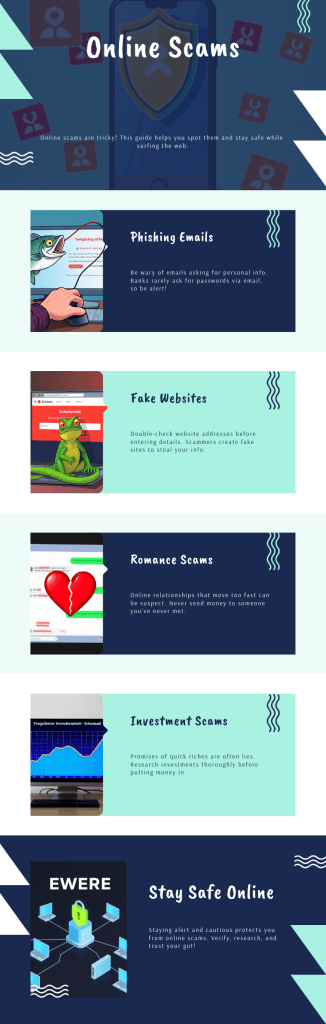
My infographic, “How to Avoid Online Scams,” was created to teach internet users how to recognize and prevent digital fraud. Using Piktochart allowed me to organize the content into clear, visually engaging sections, from identifying common scams to practical steps for protection.
I designed this infographic for the general public — anyone who shops, works, or connects online. My goal was to make it simple and eye-catching so the information can be easily remembered. Creating it also helped me become more aware of how sophisticated online scams can be and how essential digital literacy is in today’s world.
-
Hi, my name is Josh. I’m currently finishing my bachelor’s degree and I’m passionate about technology, psychology, and music. I created this blog to share my assignments and reflections from this course as part of building my e-portfolio. My long-term goals include working in technology, traveling, and continuing to learn new skills that expand my perspective.
Watch or Download this Video – https://app.animaker.com/video/205052LNLRSXPFIK
-
Hi, my name is Josh. I’m currently finishing my bachelor’s degree and I’m passionate about technology, psychology, and music. I created this blog to share my assignments and reflections from this course as part of building my e-portfolio. My long-term goals include working in technology, traveling, and continuing to learn new skills that expand my perspective.
For my recent project, I created a presentation on Social Media and Privacy, exploring how privacy policies impact users’ rights, trust, and safety in both educational and professional settings. The presentation covered the applications of social media in classrooms and workplaces, the advantages of connectivity and collaboration, the disadvantages related to data misuse and privacy risks, and the future implications of stricter regulations and AI tools for protecting personal information. Throughout the assignment process, I gained a deeper understanding of how privacy policies shape user behavior and trust, and I reflected on my own habits as an early adopter of technology. I also learned the importance of breaking complex topics into clear, engaging sections, using tools like the CHoMP method to paraphrase research effectively. Overall, this project helped me appreciate the balance between leveraging social media’s benefits and safeguarding personal data, while also strengthening my research and presentation skills.
-
Hi, my name is Josh. I’m currently finishing my bachelor’s degree and I’m passionate about technology, psychology, and music. I created this blog to share my assignments and reflections from this course as part of building my e-portfolio. My long-term goals include working in technology, traveling, and continuing to learn new skills that expand my perspective.
-
Hi, my name is Josh. I’m currently finishing my bachelor’s degree and I’m passionate about technology, psychology, and music. I created this blog to share my assignments and reflections from this course as part of building my e-portfolio. My long-term goals include working in technology, traveling, and continuing to learn new skills that expand my perspective.
-
Hi, my name is Josh. I’m currently finishing my bachelor’s degree and I’m passionate about technology, psychology, and music. I created this blog to share my assignments and reflections from this course as part of building my e-portfolio. My long-term goals include working in technology, traveling, and continuing to learn new skills that expand my perspective.
Welcome to my blog! I created this space to collect assignments, projects, and reflections from my technology course. Throughout the semester, you’ll find posts on current trends in technology, cybersecurity, artificial intelligence, blockchain, and more. This blog will also serve as part of my e-portfolio, where I can look back on what I’ve learned and share it with others. Thanks for visiting!
 Joshua Sperber